INVESTOR DECISION FRAMEWORK · 7 MIN READ
Four pillars of investing.
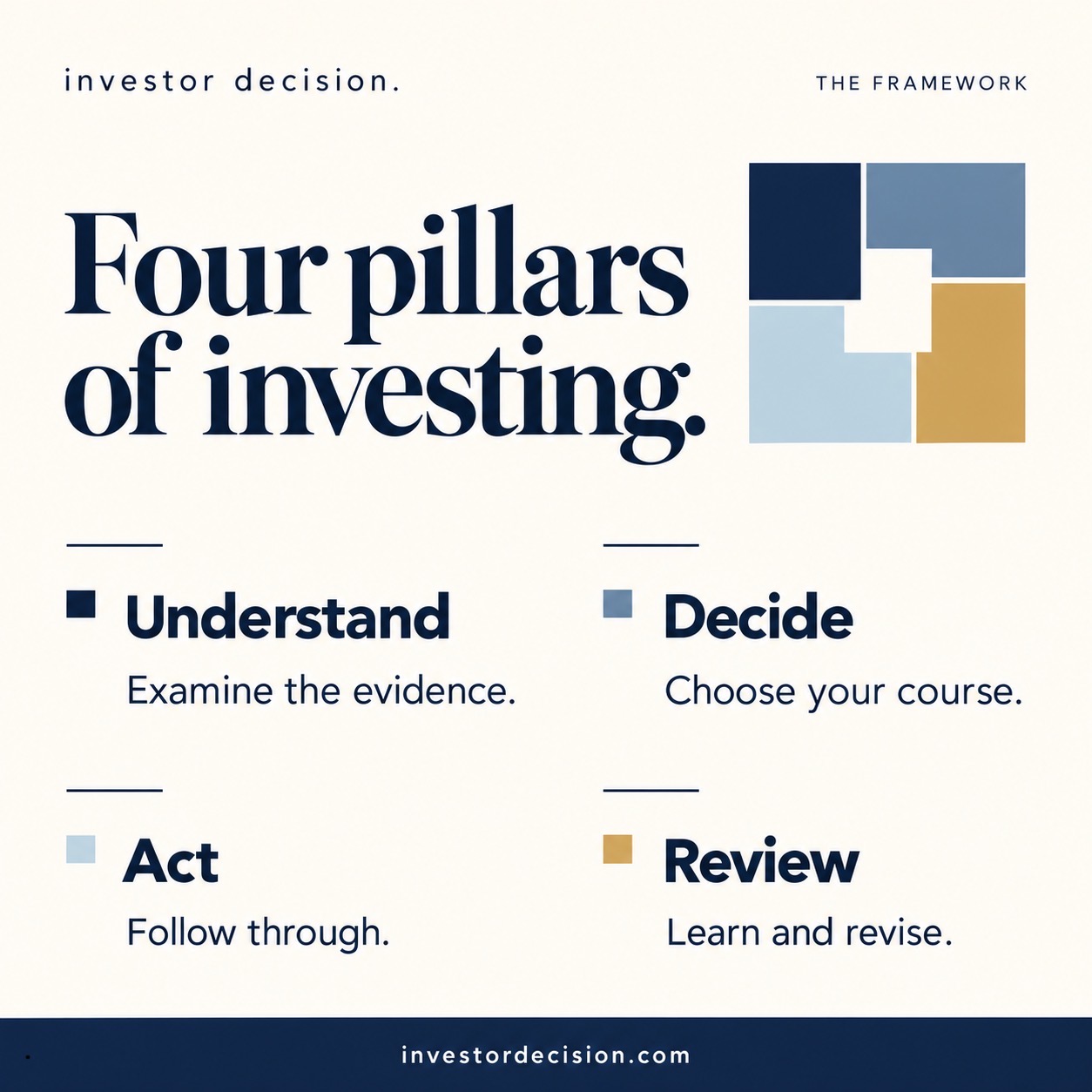
Understand. Decide. Act. Review. Four connected capabilities for carrying an investment decision through uncertainty.
October 24, 2026
An investment can make sense on paper and still be difficult to live with.
You research an idea.
You understand what supports its value. You recognise the risks. You decide how much to invest.
Then the price falls.
You open your account before breakfast. You reread the article that convinced you. You search for someone who sounds certain.
Your original reasoning becomes harder to hear.
This is why I organise my thinking about investing around four connected pillars.
Understand. Decide. Act. Review.
Four questions for locating the difficulty.
- 01
Understand
Examine the evidence. What supports this investment’s value? What evidence can I examine? Where does my knowledge end and my assumption begin?
- 02
Decide
Choose your course. Given my objectives, obligations and capacity for loss, what course should I take?
- 03
Act
Follow through. Put the decision into practice by choosing an appropriate position size, acting when conditions are met and deliberately waiting when they are not.
- 04
Review
Learn and revise. Return to the reasoning and execution. Did the evidence support my decision? Did I follow it? What did the outcome reveal?
Understand
What supports this investment’s value? What evidence can I examine? Where does my knowledge end and my assumption begin?
Decide
Given my objectives, obligations and capacity for loss, what course should I take?
An attractive investment may still be unsuitable for the money I need next year.
Act
Put the decision into practice.
That includes choosing an appropriate position size, following through when conditions are met and deliberately waiting when they are not.
A decision to hold needs to survive the discomfort of watching prices move.
Review
Return to the reasoning and the execution.
Did the evidence support my decision? Did I follow it? What did the outcome reveal?
A profit can encourage me to repeat a mistake I have not recognised. A loss deserves examination before I conclude that the decision was poor.
Find where the difficulty lies
These pillars keep bringing me back to my own responsibility.
When I feel uncertain, I can ask where the difficulty lies.
Do I need to understand more?
Reconsider the decision?
Follow through?
Or learn from what happened?
That gives me a more useful starting point than checking the price again.
I want to become an investor who can explain a decision, carry it out and revise it when the evidence changes.
That is the capacity I am working to build.